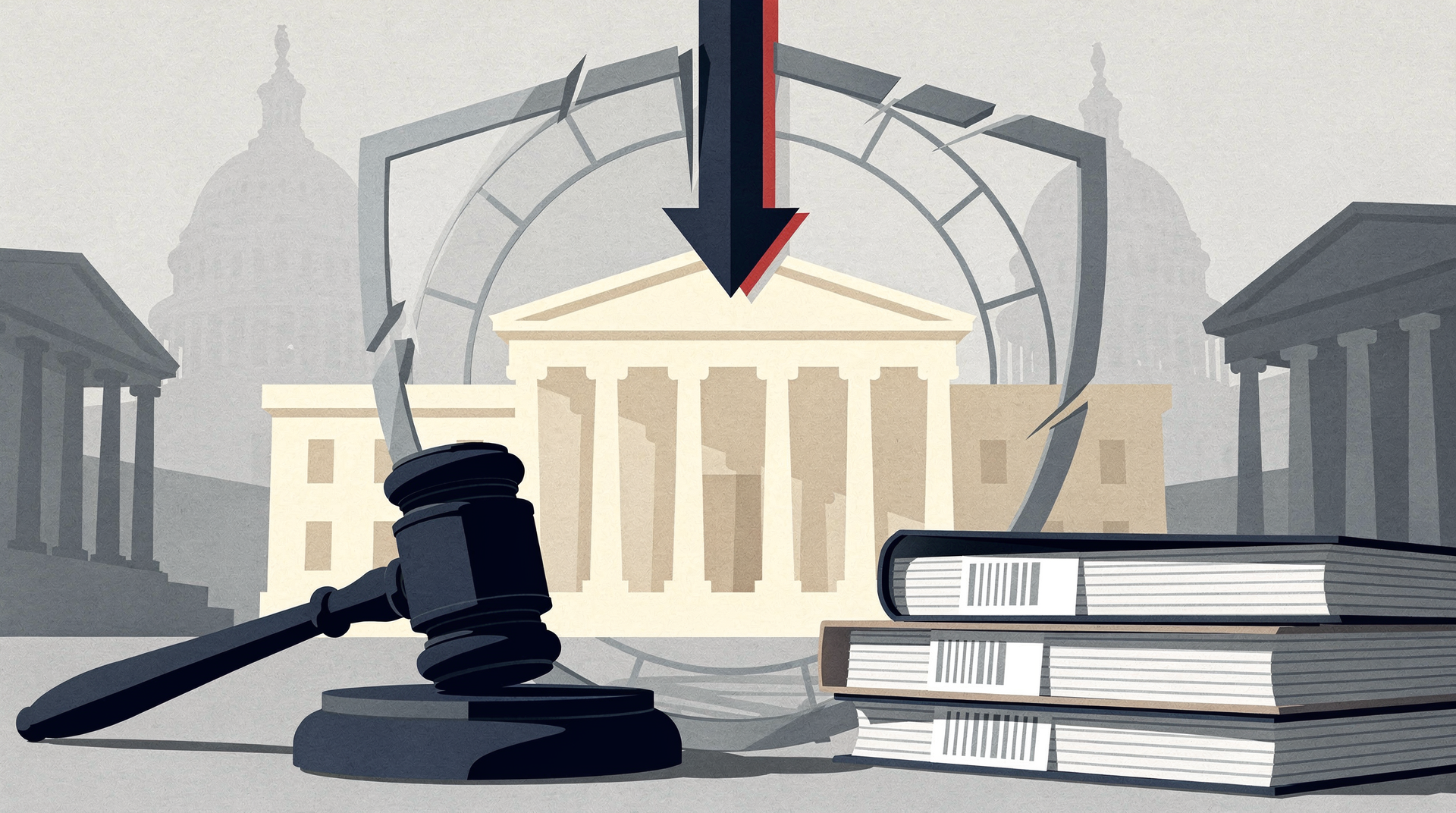
The Supreme Court ruled on Monday that President Trump has the constitutional authority to fire Federal Trade Commission commissioners at will. The decision overturned the 91-year-old precedent set by Humphrey’s Executor v. United States, which had shielded independent regulatory agencies from direct presidential control.
The 6-3 decision in Trump v. Slaughter, written by Chief Justice John Roberts, held that statutory “for cause” removal protections for FTC commissioners are “contrary to the separation of powers enshrined in the Constitution.”
The ruling adopted the Court’s interpretation of presidential removal authority under the Constitution and applies to the FTC. It also has implications for other independent agencies, including the FCC, SEC, CFPB and NLRB, whose leaders have historically been protected from at-will removal.
The decision may affect agency leadership, pending enforcement actions and ongoing rulemakings at agencies with similar removal protections.
“What text, history, and structure settle, our precedent confirms — the President may remove his subordinates at will,” Roberts wrote.
In a companion case, Trump v. Cook, the Court ruled 5-4 to preserve removal protections for members of the Federal Reserve Board. Roberts, joined by Justice Brett Kavanaugh and the Court’s three liberal justices, wrote that “not only the fact of independence but also the appearance of independence is key to the Federal Reserve’s design,” according to UPI’s report on the paired decisions. The case arose from Trump’s attempt to remove Federal Reserve Governor Lisa Cook, which the Court blocked.
Sen. Chris Coons (D-DE) criticized the Slaughter decision, saying it “will bring the kind of leadership chaos we’ve seen at the Department of Homeland Security, the Department of Justice, and the Office of the Director of National Intelligence to agencies that protect workers, keep our economy on track, and regulate our internet and our elections.” He said the ruling could leave Americans “struggling with more expensive internet, fewer consumer protections, and more dangerous workplaces,” adding that when “President Trump doesn’t like our economic numbers, his answer is not to accept responsibility, or to enact policies that will make them better — it’s just to fire people.”
Coons also said the Federal Reserve exception was “paramount,” stating that “the independence of the Federal Reserve is part of the foundation of the American economy and a benchmark for the world.”
The Slaughter case arose from Trump’s March 2025 removal of FTC Commissioner Rebecca Slaughter without citing the statutory grounds of “inefficiency, neglect of duty, or malfeasance in office” required under the FTC Act. A legal analysis by the law firm Mayer Brown said the Court “declined to address how far its holding might extend” beyond the FTC, explaining that it did not have “occasion today to define the bounds of what such power entails.” The analysis said additional litigation involving agency design is expected, including challenges to fixed terms, holdover provisions and political-balance requirements at multi-member agencies.
Justice Sonia Sotomayor, writing in dissent, said the majority had given the president “far greater power than ever before” — a power “that neither the People, nor Congress, nor the Constitution bestowed upon him.”
The decision leaves unresolved how its reasoning will apply to other independent agencies. Similar removal challenges involving the NLRB and MSPB are pending, and agencies with comparable statutory protections may face additional litigation over their leadership structures.