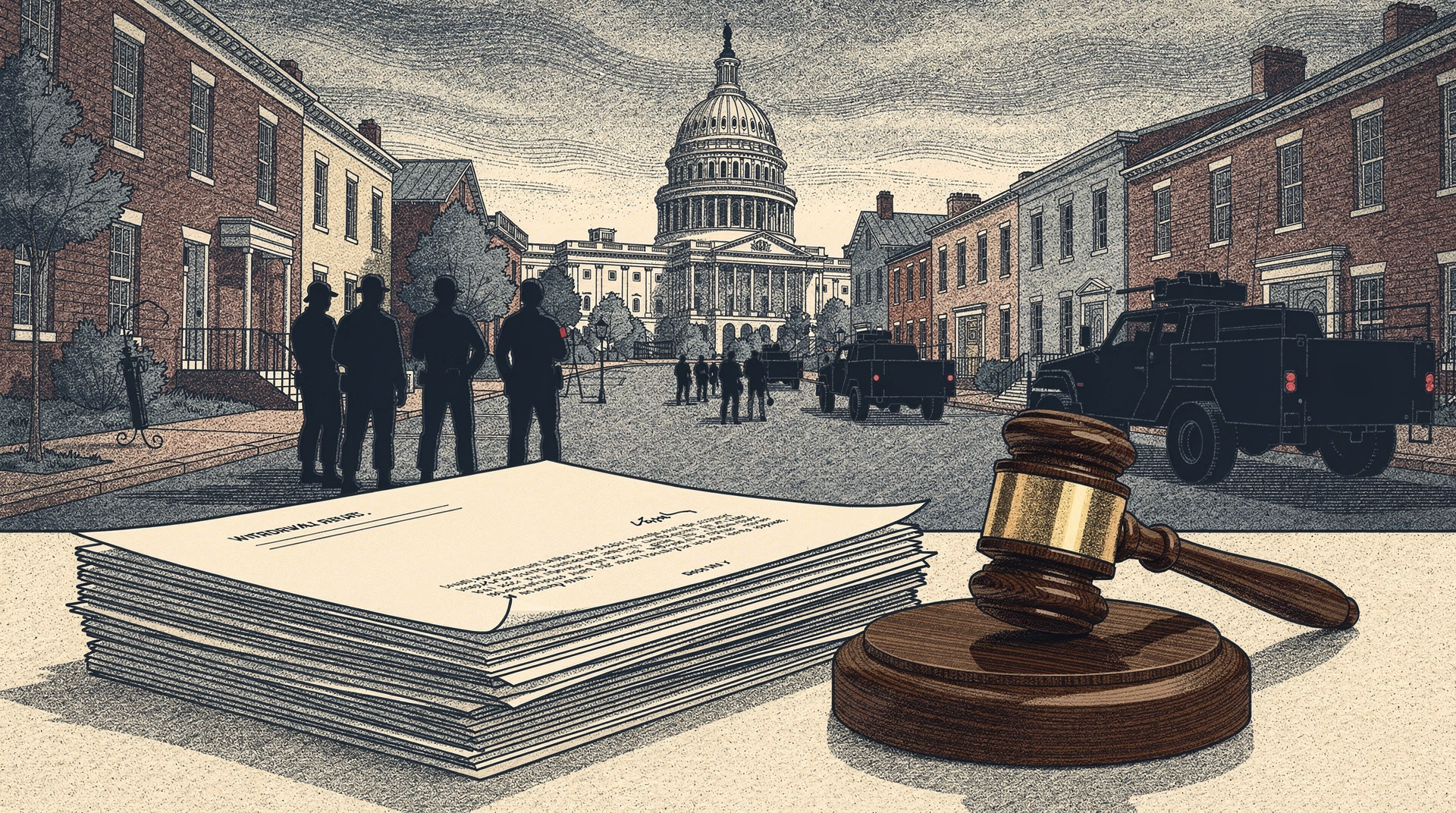
The National Guard deployment in Washington, D.C., has been extended through 2029, even as the D.C. Council has formally requested the troops’ withdrawal and the American Civil Liberties Union has escalated legal and advocacy efforts challenging the military presence in the nation’s capital.
The League of Women Voters of the District of Columbia reported in its Aug. 7 Full Rights Update that Guard troop numbers in the city have been growing rather than shrinking, a trend the organization said has accelerated since late June. The D.C. Council on July 10 passed a formal request calling for the Guard’s withdrawal, a demand that has so far gone unanswered by federal authorities.
The multiyear extension of the deployment, first reported by the LWVDC on July 17, represents one of the longest sustained National Guard presences in D.C. outside of wartime. The authorization came from federal authorities, though the specific legal mechanism and the Department of Defense’s stated justification for maintaining and expanding the force have drawn scrutiny from local officials and civil liberties organizations.
Street protests against the deployment have continued across the District, the LWVDC reported, with demonstrators citing concerns about the militarization of civilian neighborhoods and the chilling effect on free assembly.
The ACLU has launched an active legal and advocacy campaign in response to the deployment. While the organization has not disclosed the full scope of its legal strategy, its efforts are expected to challenge the constitutional authority under which the Guard is operating in a jurisdiction whose elected government has explicitly opposed the presence.
The confrontation deepened on July 25 when Congress moved to interfere with D.C.’s budget and funds, a step the D.C. Fiscal Policy Institute later characterized as part of a broader pattern of federal encroachment on District autonomy. The budget action raised alarms among local officials that federal lawmakers are using the appropriations process to pressure the District on matters beyond its spending.
The sustained Guard deployment has practical consequences for D.C. residents and businesses. Military vehicles and personnel have become a visible presence in several neighborhoods, and community leaders have raised concerns about the impact on commercial corridors and quality of life. The deployment also raises questions about cost: who is paying for the extended operation, and whether those federal resources could be directed to local priorities.
The D.C. Council, Mayor Muriel Bowser’s administration, and the Department of Defense have not reached any public agreement on a drawdown timeline. Federal officials have not publicly responded to the Council’s July 10 withdrawal request.
The LWVDC urged residents to contact their representatives and participate in ongoing advocacy efforts, noting that the situation represents a fundamental test of D.C. home rule — the principle that the District’s elected government should control local affairs without federal override.
The standoff unfolds against a backdrop of related federal actions. A House committee has separately advanced legislation that would strip D.C. of control over its own tax code, compounding fears among District leaders that the city’s limited self-governance is under coordinated assault from multiple directions in Congress.
For D.C. residents, the Guard deployment is more than a political dispute — it affects daily life in neighborhoods where troops are stationed, raises civil liberties questions about protest and assembly, and tests whether the District’s elected leaders have meaningful authority over their own city.