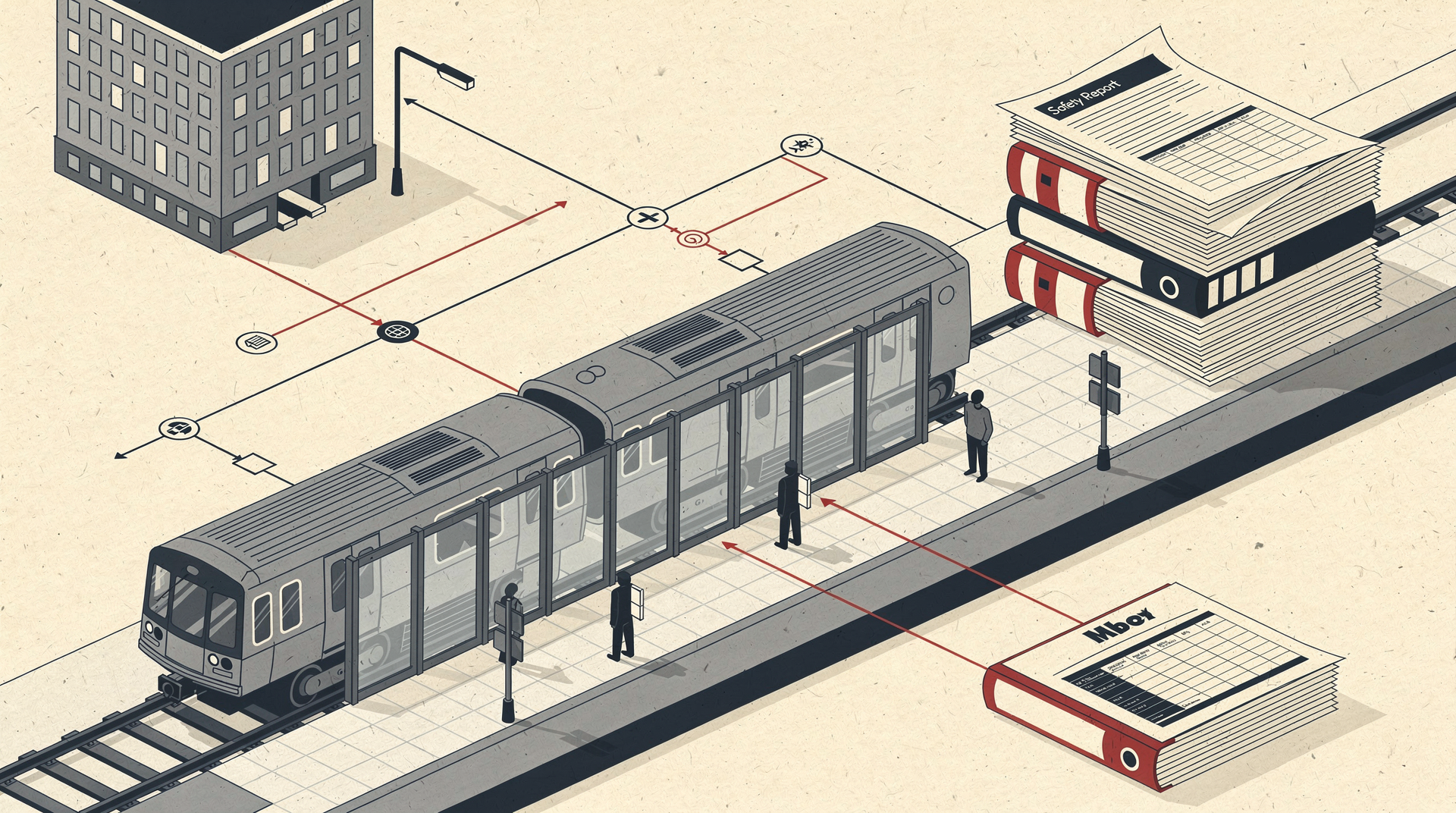
Metro is proposing to install glass platform barriers approximately 5 feet, 6 inches tall on the Red Line, its busiest corridor, with a vote before the WMATA Board of Directors scheduled for Thursday, WTOP reported this week.
The proposal comes in response to an alarming safety record: in 2026 alone, more than 80 people have trespassed onto Metro tracks and 10 have died, with incidents occurring roughly every three days. Beyond the human toll, each track intrusion causes significant service delays system-wide, disrupting commutes for hundreds of thousands of riders across the Washington region and imposing cascading costs on the transit agency and the regional economy.
Platform edge doors — glass barriers that align with train doors and open only when a train is stopped at the station — are common in newer transit systems in Asia, Europe, and the Middle East but remain exceptionally rare in the United States. No major American legacy rail system currently operates full-height platform doors at scale. The Federal Transit Administration has studied platform safety measures as part of its broader transit safety oversight, though no federal mandate requiring platform doors currently exists, and the technology has not been widely adopted in the American transit context.
WMATA has not publicly released a firm cost estimate or deployment timeline for the Red Line barriers. The financial question is significant: platform door installations on comparable systems abroad — including in London, Seoul, and Singapore — have run into hundreds of millions of dollars, and WMATA’s capital budget is already stretched by ongoing investments in new 8000-series rail cars, signal upgrades, and state-of-good-repair maintenance across the aging system.
The platform doors would complement recent Red Line modernization investments, including new signaling systems and automated train technology that WMATA has been testing. Automated train operations, which remove the need for a human operator to judge platform clearance before departure, are technically better suited to work with platform doors — a factor that may have influenced WMATA’s decision to pilot the barriers on the Red Line first rather than across the full system.
The funding question will be central to Thursday’s board deliberation. WMATA’s capital program relies on a combination of federal grants, dedicated state and local funding from Virginia, Maryland, and the District of Columbia, and federal formula allocations under the Bipartisan Infrastructure Law. Whether the platform door project qualifies for competitive federal infrastructure grant programs — such as FTA Capital Investment Grants or safety-focused discretionary programs — or whether it must be funded entirely from the existing regional compact could determine both the project’s pace and its scope.
The safety data driving the proposal is difficult to ignore. An average of one track intrusion every three days in 2026 suggests a systemic problem that operational changes alone — public awareness campaigns, station attendants, lighting improvements — have failed to solve. Platform doors represent a physical, engineering-based solution that addresses the root vulnerability.
If approved, the Red Line platform doors would position WMATA as one of the first legacy transit systems in the United States to deploy the technology at scale — a distinction that could influence other agencies facing similar safety challenges. Thursday’s board vote will determine whether the proposal advances to detailed engineering and procurement or remains at the conceptual stage pending further study.