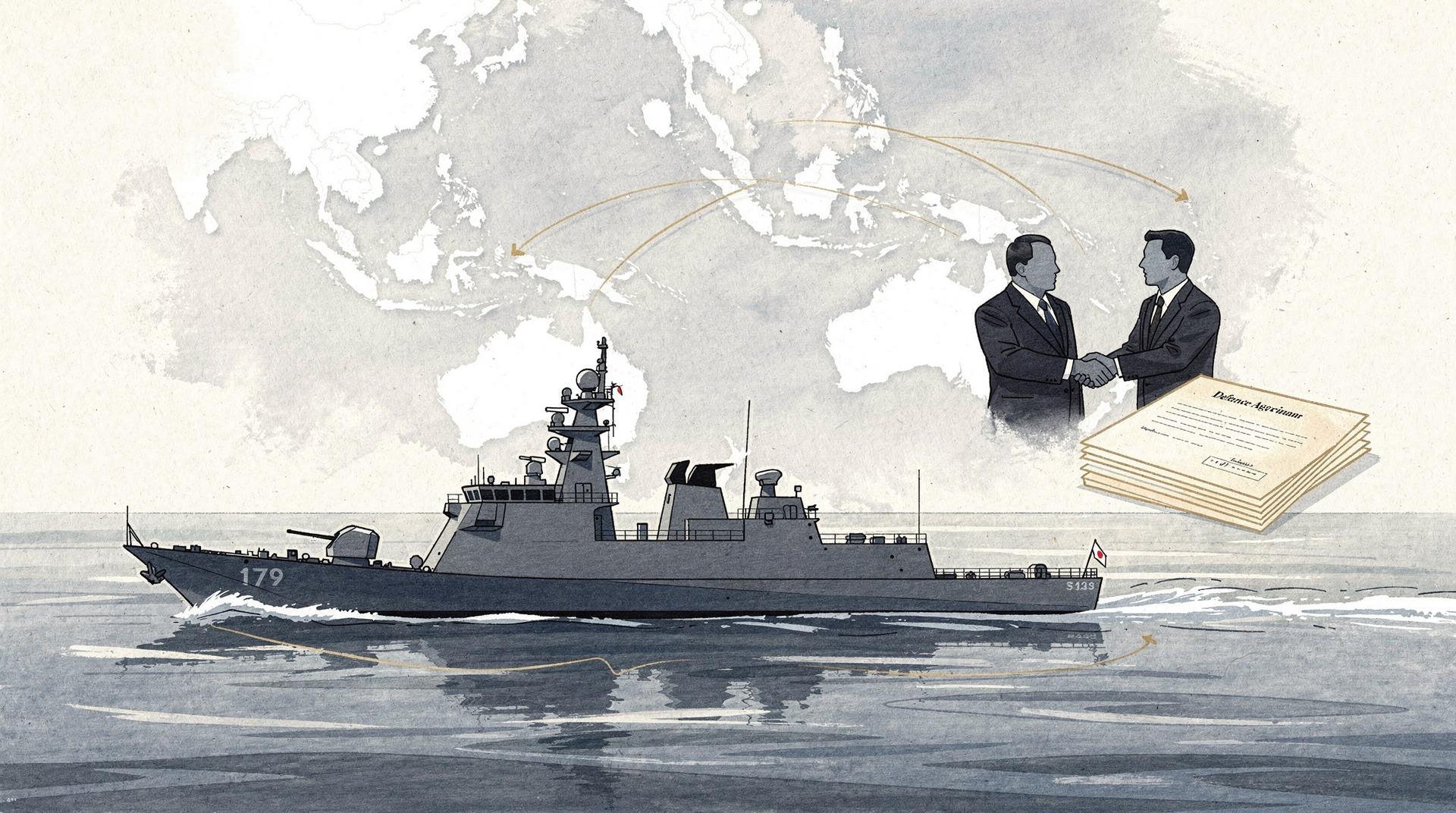
Japan has entered the global defense export market with the sale of Mogami-class frigates to Australia, marking the most significant departure from Tokyo’s post-World War II restrictions on arms transfers, according to a CSIS commentary published on Tuesday.
The analysis traced Japan’s path from decades of near-total prohibition on defense exports through former Prime Minister Shinzo Abe’s 2014 Three Principles reform to the current inflection point, describing the Mogami sale as a watershed moment for Japanese defense industry and Indo-Pacific security architecture.
Japan’s defense sector — previously confined to serving only the Japan Self-Defense Forces — is now positioned to compete internationally as both a partner and a potential rival to U.S. and allied defense producers. The Mogami-class frigate, a compact, multi-mission warship designed for modern naval warfare, represents a competitive entry into a global market traditionally dominated by American, European, and South Korean manufacturers.
The timing of Japan’s defense industrial emergence coincides with U.S. efforts to diversify allied production capacity amid critical munitions shortfalls. With American interceptor and precision munitions stockpiles depleted after recent conflicts, allied nations capable of contributing to defense production — including Japan — have taken on increased strategic significance.
The sale also reflects a deepening trilateral security alignment among the United States, Japan, and Australia, with implications for interoperability and defense logistics across the Indo-Pacific. U.S. Embassy Tokyo, a priority diplomatic post, manages the bilateral defense relationship that underpins Japan’s expanding role.
For Washington, the development presents both opportunities and complexities. A more capable and export-active Japanese defense industry strengthens allied deterrence, but it also introduces a new competitor into markets where American firms have historically dominated. How the United States navigates that balance — through Embassy Tokyo and bilateral defense trade mechanisms — will shape the next chapter of the alliance.