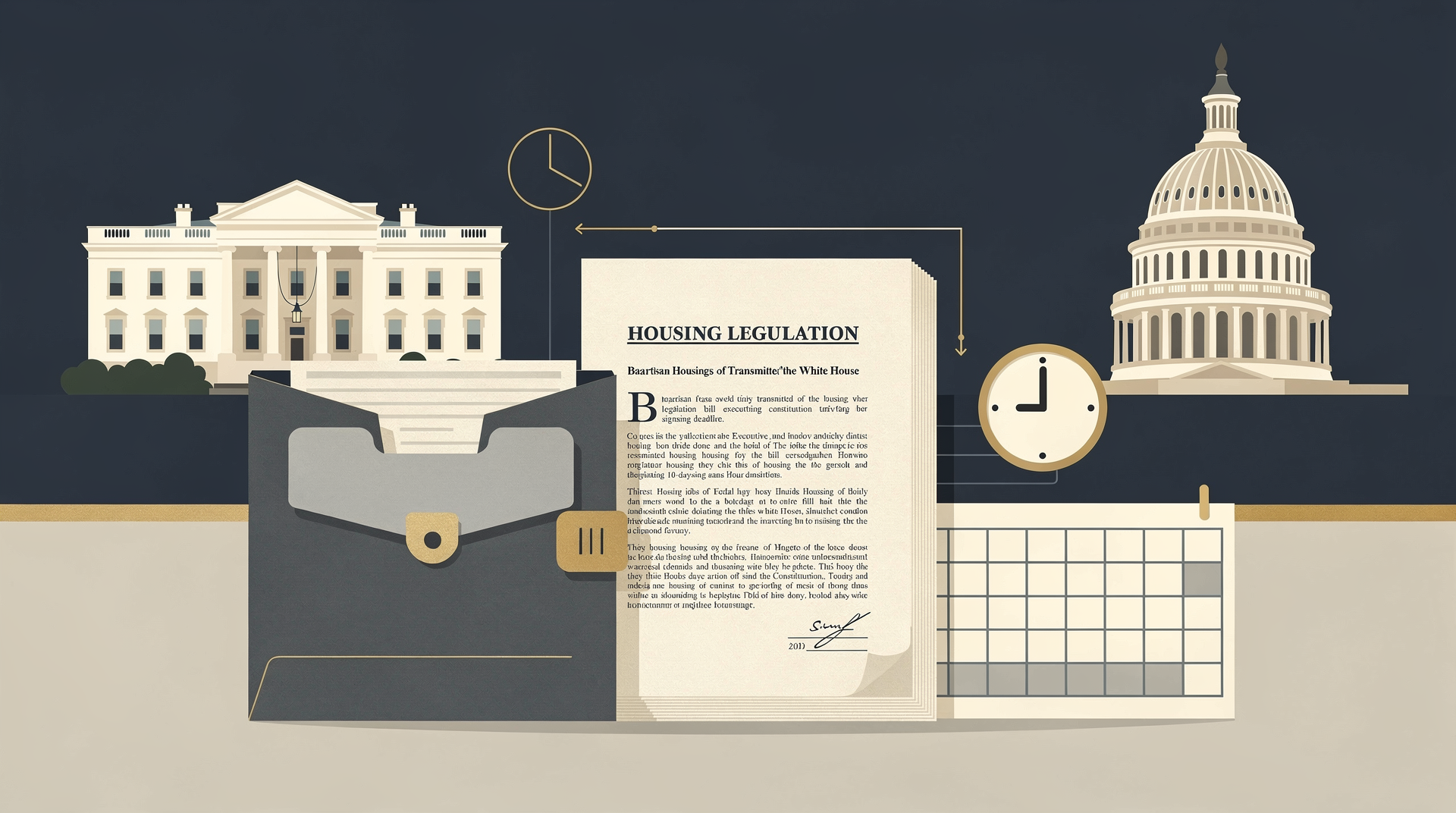
Speaker Mike Johnson announced Sunday that he will formally transmit the 21st Century ROAD to Housing Act to the White House on Monday, beginning the 10-day constitutional period in which President Trump must sign or veto the legislation, or allow it to become law without his signature.
Under Article I, Section 7 of the Constitution, a bill becomes law after 10 days if the president takes no action while Congress remains in session. A pocket veto is available only if Congress adjourns before the 10-day period expires. The House is scheduled to remain in session through pro forma meetings during the July 4 recess.
The House passed the legislation by a vote of 358-32, and the Senate approved it 85-5. Trump canceled a planned signing ceremony on June 24, saying on Truth Social that he would not sign the bill until the Senate passed the SAVE America Act, a voter ID measure, according to BBC News.
“Today’s Housing News Conference and Signing is hereby cancelled until such time as we pass the desperately needed SAVE AMERICA ACT, which I consider to be a National Emergency,” Trump wrote.
The Senate began a two-week July 4 recess without taking up the SAVE America Act. The measure would require 60 votes to advance under current Senate rules. Senate Majority Leader John Thune said the housing bill “has been worked on for a long time” and expressed hope that Trump would sign it.
The 381-page housing package contains more than 40 provisions related to housing construction, financing and homeownership. Among its provisions, the bill establishes financial penalties for certain large institutional purchases of single-family homes, creates a $200 million grant program for local governments that revise zoning regulations, streamlines environmental reviews for certain Department of Housing and Urban Development projects, and expands access to mortgages under $100,000.
According to ABC News, the legislation received support from homebuilders, apartment owners and housing advocacy organizations. Some analysts told the outlet the bill addresses several housing policy issues but does not resolve all factors affecting housing affordability, including labor shortages and insurance costs.
If Trump vetoes the bill, Congress has approved it by margins that exceed the two-thirds threshold required for an override. If he neither signs nor vetoes the measure while Congress remains in session, it will become law after the 10-day constitutional period expires.
The House returns after the July 4 recess with both the housing legislation and the SAVE America Act remaining pending issues.