

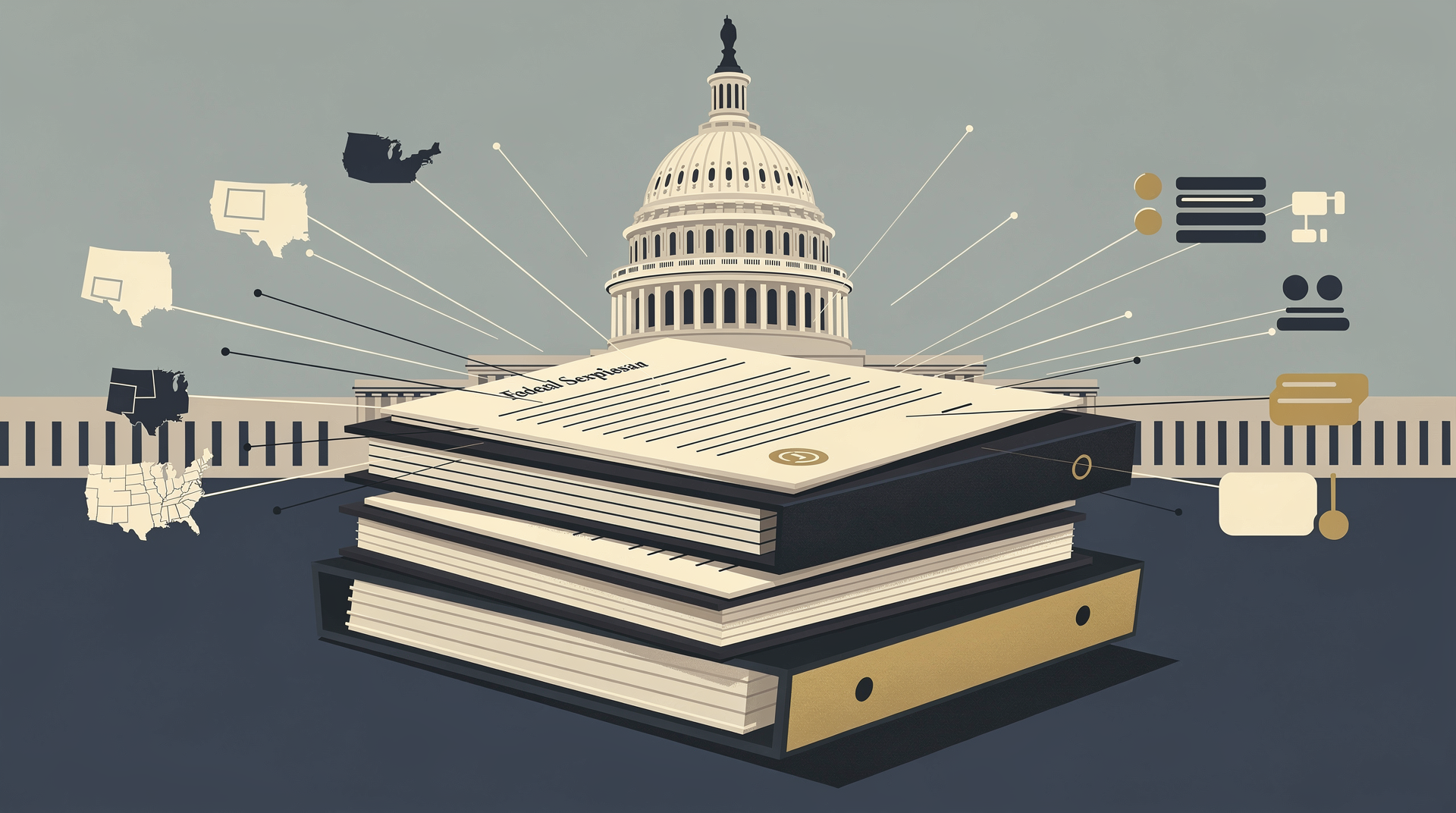
Reps. Jay Obernolte (R-Calif.) and Lori Trahan (D-Mass.) have released the Great American Artificial Intelligence Act, a 269-page bipartisan discussion draft that would establish a federal framework for artificial intelligence governance.
The draft includes a three-year preemption of certain state laws regulating AI developers while preserving state authority over AI deployment and use.
According to a June 17 analysis by the Cato Institute, the bill would require transparency reports from “large frontier AI developers,” defined as companies with more than $500 million in annual revenue. The legislation would also establish a Center for AI Standards and Innovation, funded at $100 million annually, provide antitrust protections for certain cybersecurity collaborations, and create AI workforce training programs through the National Science Foundation and Department of Labor.
The Cato Institute noted that several provisions, including the Center for AI Standards and Innovation, the transparency requirements and the state preemption provision, would expire after three years unless renewed.
Under the proposal, qualifying AI developers would be required to publish information describing their model development, risk mitigation practices, cybersecurity measures and deployment criteria. Independent Verification Organizations licensed by the Center for AI Standards and Innovation would be responsible for auditing compliance.
In its analysis, Cato wrote that third-party verification could provide greater independence from direct government oversight, while also noting potential concerns associated with government licensing programs.
According to Tech Policy Press, the state preemption provision has drawn criticism from organizations including Public Citizen, Public Knowledge and the AFL-CIO. The publication reported that supporters include the Business Software Alliance and the Information Technology Industry Council.
Tech Policy Press also reported that co-chairs of the House Commission on AI, including Rep. Ted Lieu (D-Calif.), said the draft “cannot serve as the basis for productive dialogue.”
An Annenberg Public Policy Center survey cited by Tech Policy Press found that 65 percent of Americans believe the government has done too little to regulate artificial intelligence, including 77 percent of Democrats and 53 percent of Republicans.
Separately, the Competitive Enterprise Institute and other organizations have opposed efforts to attach AI-related provisions to the App Store Accountability Act and the Kids Online Safety Act.
Obernolte and Trahan described the proposal as an initial draft in a June 4 Bloomberg Law op-ed.
“This discussion draft isn’t a final product,” the lawmakers wrote. “It’s the start of a serious national conversation.”