

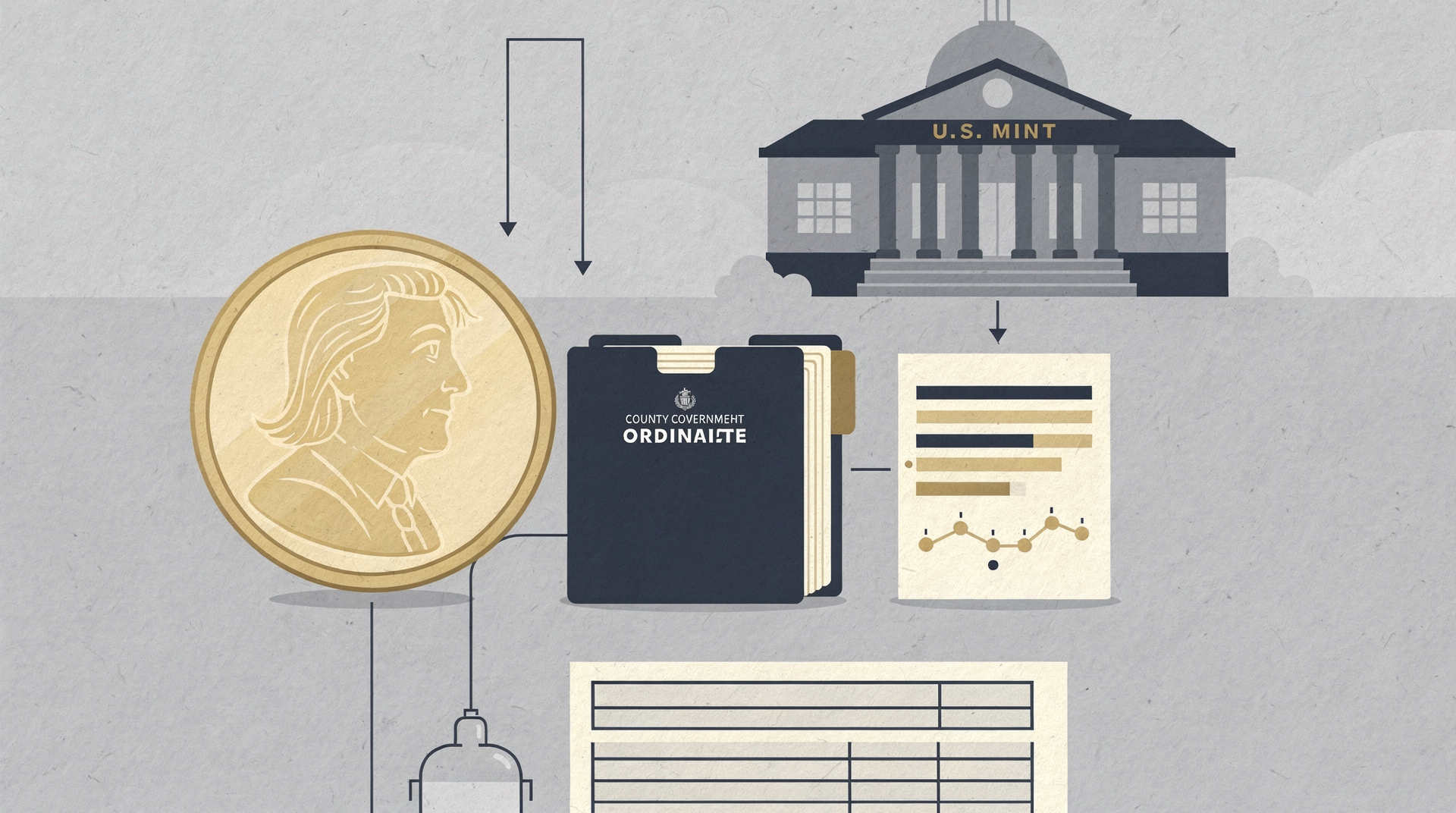
Fairfax County has approved a temporary ordinance to round all in-person cash transactions for county taxes and fees to the nearest nickel, a direct response to the U.S. Mint’s decision last November to cease production of new pennies, according to a report by WTOP.
The move offers a clean case study in how a single federal policy decision — ending production of the nation’s lowest-denomination coin — cascades through the regulatory chain, forcing adaptations at the state legislative level and ultimately at the county government counter where residents pay their bills.
Under Fairfax County’s rounding plan, cash transaction totals ending in 1, 2, 6, or 7 cents will be rounded down in the customer’s favor, while totals ending in 3, 4, 8, or 9 cents will be rounded up. Transactions ending in 0 or 5 cents are unaffected. The rounding applies only to in-person cash payments at county offices; electronic transactions — including online payments, credit card charges, and direct debits — continue to calculate to the exact cent and are not subject to rounding.
The county acted after the Virginia General Assembly passed enabling legislation during its 2026 session, authorizing local jurisdictions to implement rounding policies for cash transactions. Without that state-level authorization, counties would have faced legal uncertainty about unilaterally modifying the exact amounts due on tax bills and fees — amounts typically set by ordinance or state code to the penny.
The Mint’s decision to halt penny production followed years of debate over the coin’s cost-effectiveness. The penny has cost more to produce than its one-cent face value for over a decade — the Mint reported production costs of roughly 3.07 cents per penny in its final year of production. Countries including Canada, Australia, New Zealand, and several European nations eliminated their lowest-denomination coins years ago without significant consumer disruption, and economic research has generally found that symmetric rounding schemes produce negligible net impact on consumers.
For Fairfax County, the practical trigger was immediate and tangible: the dwindling penny supply at county payment locations caused instances where clerks could not provide correct change, creating confusion and slowing transactions for residents paying property taxes, vehicle registration fees, and other county charges. The temporary ordinance is designed to standardize the process while the county evaluates whether a permanent policy change is warranted.
The consumer impact of the rounding policy is designed to be neutral over time. The rules are symmetric — four values round down and four round up — meaning that across a sufficient number of transactions, the net financial effect on any individual taxpayer should approach zero. Consumer advocates have noted that the rounding is applied only to the final transaction total, not to individual line items, which prevents compounding.
Whether Congress will address rounding at the federal level — creating a uniform national standard rather than the emerging patchwork of state-by-state solutions — remains an open question. No federal legislation mandating a specific rounding methodology for cash transactions has been introduced. In the absence of federal action, jurisdictions across the country are devising their own approaches, creating the potential for inconsistent rules that could confuse consumers and businesses operating across state and county lines.
Other jurisdictions in the Washington region are expected to adopt similar measures in the coming months as existing penny supplies continue to dwindle.