

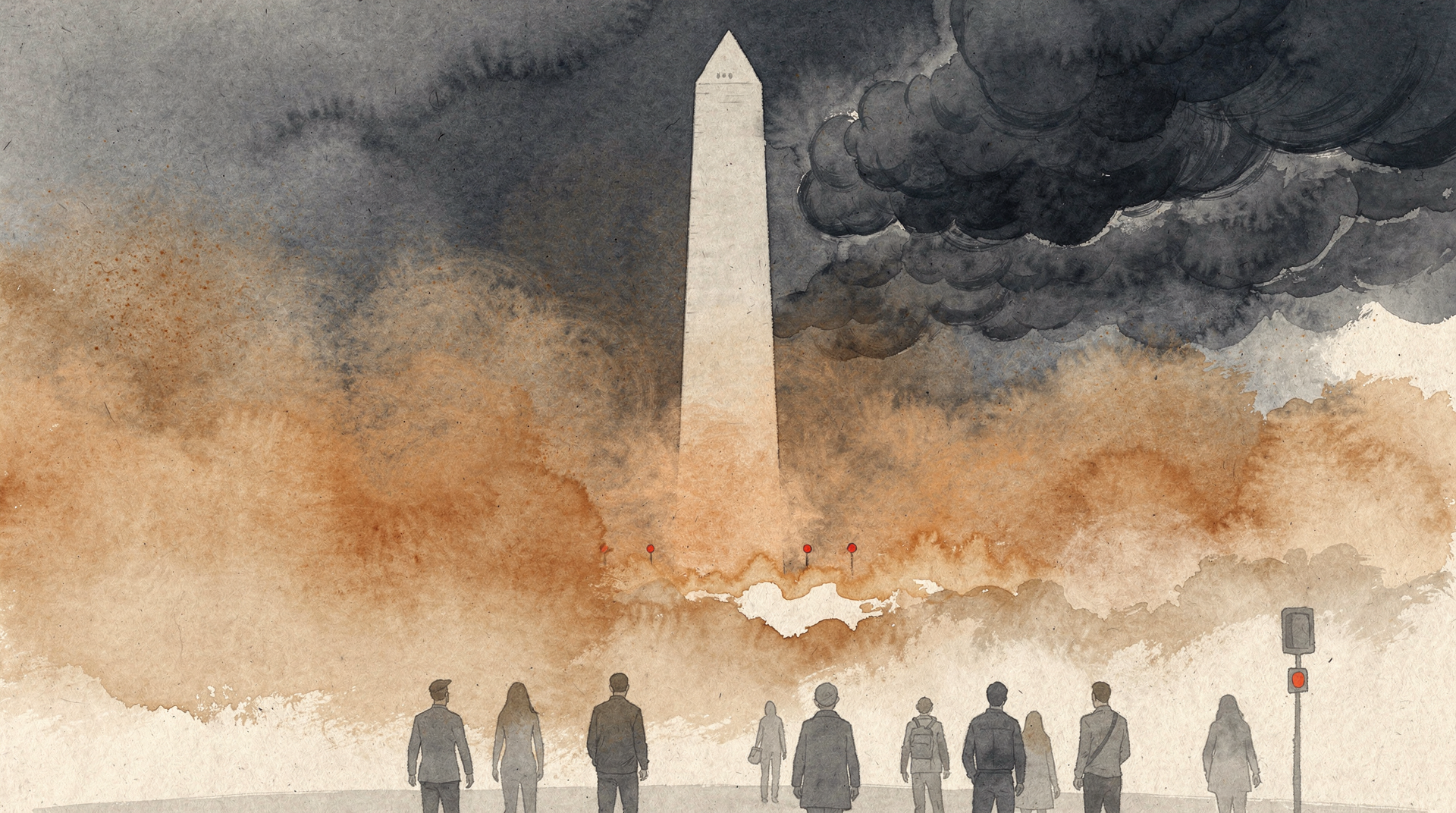
Smoke from Canadian and Minnesota wildfires engulfed Washington on Friday and Saturday, driving the District’s air quality to among the worst readings in the world as the city simultaneously operated under an Extreme Heat Alert with heat indices exceeding 105°F.
The compound emergency — wildfire smoke, extreme heat, and severe thunderstorms converging in a 48-hour window from July 17–18 — forced pool closures, event cancellations, and a public health advisory for children, the elderly, and people with respiratory conditions. For federal agencies operating in the capital, the episode tested emergency protocols and raised questions about how recurring multi-hazard events should be classified and resourced.
DC Health issued a Red Air Quality Alert, warning residents to limit outdoor activity as particulate matter from distant wildfires settled over the region. The Washington Monument and Lincoln Memorial were visible only through thick orange haze in images that circulated widely on social media. The Air Quality Index reached Code Purple levels — the most severe classification — meaning the air was “very unhealthy” for all residents, not just sensitive populations. The alert came as temperatures pushed the heat index well past 100°F, creating dangerous conditions for outdoor workers, unhoused residents, and anyone without access to air conditioning.
The combination of extreme heat and poor air quality is particularly dangerous because heat drives people outdoors to seek ventilation while smoke pollution makes outdoor air itself a health hazard — trapping vulnerable populations in a no-win scenario. Emergency rooms across the region reported increased visits for respiratory distress and heat-related illness during the 48-hour event window.
By Saturday evening, severe thunderstorms rolled through the DMV, knocking out power for more than 27,000 customers and causing significant property damage across the District, Maryland, and Northern Virginia. The storms temporarily cleared the smoke, and Sunday brought improved air quality — but meteorologists cautioned that shifting wind patterns could push wildfire smoke back into the region within days.
The episode marks the latest in a pattern of smoke intrusions from distant wildfires affecting the Eastern Seaboard, a phenomenon that has accelerated in recent years as wildfire seasons grow longer and more intense. The Environmental Protection Agency’s current air quality standards and monitoring frameworks were not designed for the frequency of long-range smoke events now reaching the Mid-Atlantic.
For the federal workforce concentrated in the capital, the compound crisis raised practical questions about workplace safety, telework activation, and continuity of operations. The Office of Personnel Management and the General Services Administration, which manage federal employee policies and building operations respectively, have faced scrutiny over how quickly guidance reaches workers during fast-moving environmental emergencies.
The weekend’s convergence of hazards underscored a growing challenge for emergency management agencies: how to communicate risk and allocate resources when heat, smoke, and storms overlap rather than arrive sequentially. FEMA’s disaster classification framework currently treats these as separate events — a structure public health experts say may need updating to reflect the reality of compound emergencies that are becoming more common across the Eastern United States.