DC Water completed the first of four emergency repair projects on the Potomac Interceptor sewer line this week, finishing work on a 600-foot section beneath Dulles International Airport after inspections revealed serious structural deterioration inside the 54-mile regional sewage conduit.
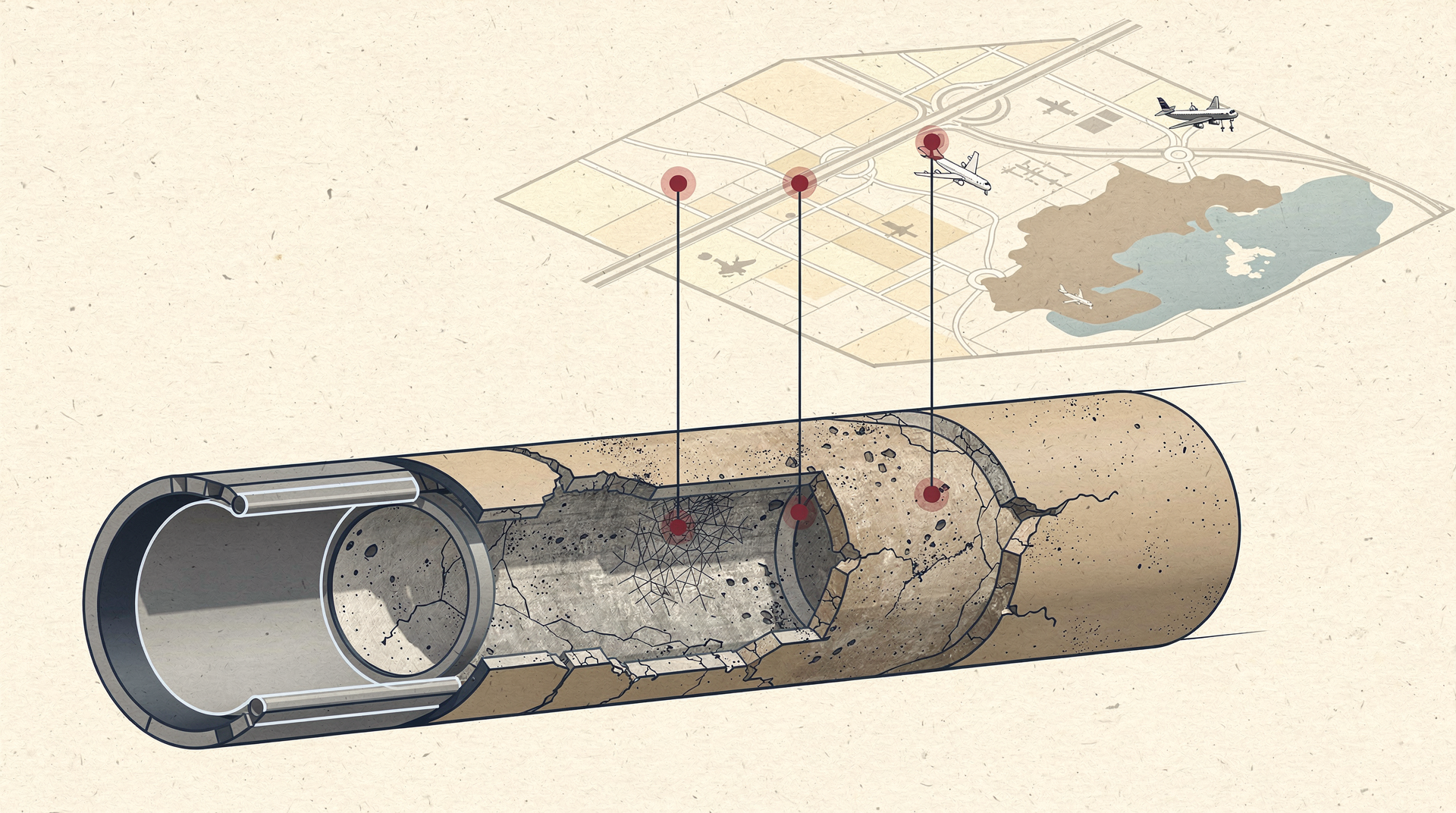
Inspection crews found significant corrosion, worn concrete, and exposed steel supports inside the aging pipe, according to a DC Water news release, prompting the utility to classify the work as an emergency intervention rather than routine maintenance.
Repair crews used a cured-in-place pipe lining system, or CIPP, to restore the damaged section — a trenchless technology that installs a resin-saturated liner inside the existing pipe and cures it to form a new structural wall without excavation.
Interim CEO Matthew Brown called the Dulles project “an important milestone as we work to address aging sewer infrastructure” but acknowledged that three additional repair sites remain on the Potomac Interceptor’s path across the region.
The remaining sites are at Broad Run in Loudoun County, Virginia; Pennyfield Lock near Potomac, Maryland; and the Clara Barton Parkway along the Maryland-DC border. Each site has been identified as requiring emergency-level attention, raising questions about the risk of failure at locations that have not yet been repaired.
The Potomac Interceptor serves as the primary sewage conveyance for a vast portion of the Washington region, transporting wastewater from communities in Virginia and Maryland to DC Water’s Blue Plains Advanced Wastewater Treatment Plant — the largest facility of its kind in the world. A failure at any point along the line could result in raw sewage discharges into the Potomac River watershed.
The funding mechanism for the remaining repairs has not been publicly detailed. DC Water, which operates as an independent authority, funds capital projects through ratepayer revenue and bond issuances. Whether federal infrastructure dollars from recent legislation will be applied to the Potomac Interceptor work remains an outstanding question for ratepayers and the jurisdictions the line serves.