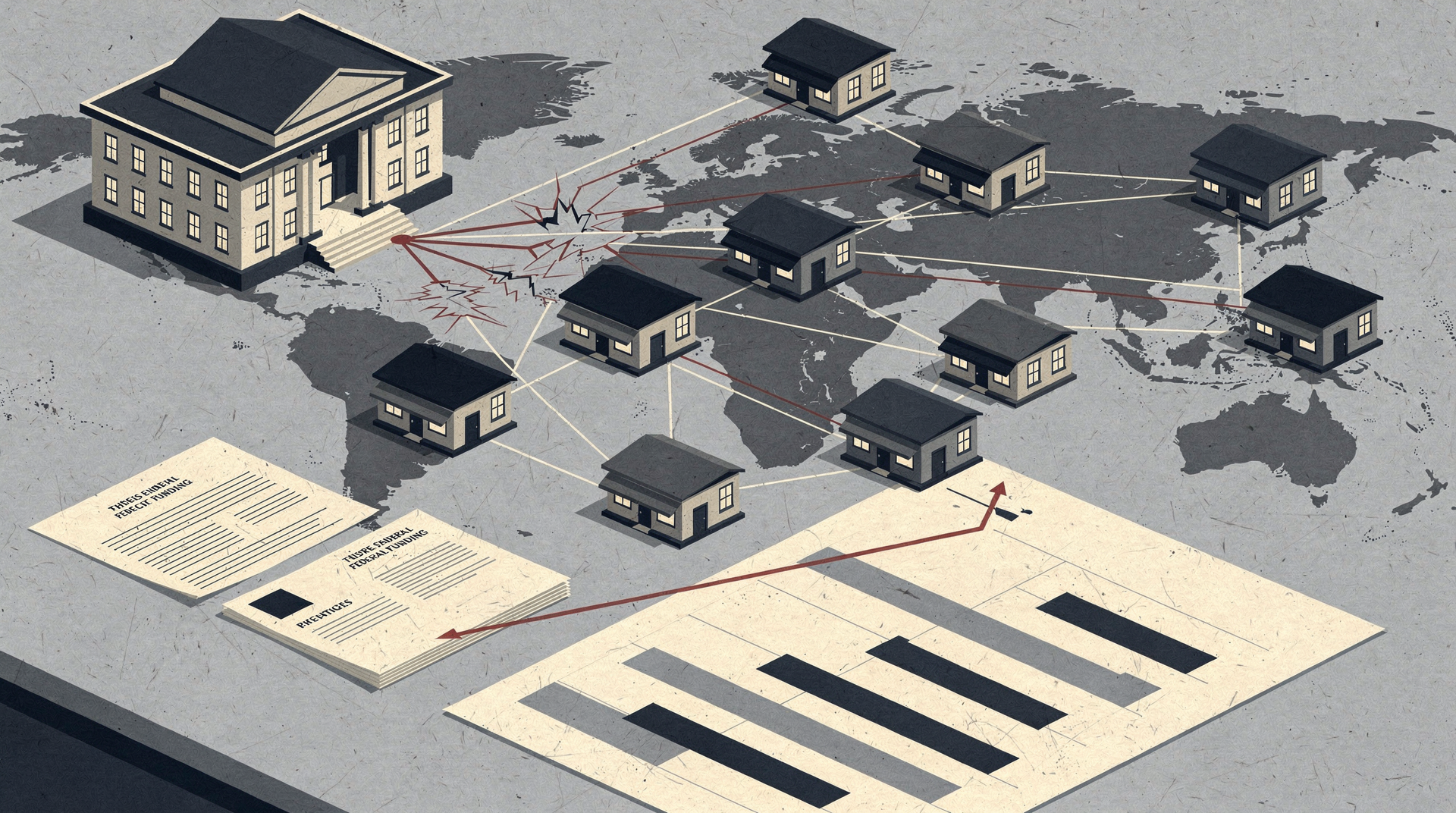
Roughly 7 in 10 civil society organizations that depend on U.S. government funding are expected to close as a result of sweeping foreign assistance cuts that have eliminated tens of billions of dollars in awards since 2025, according to a commentary published Monday by the Center for Strategic and International Studies.
The CSIS analysis, authored by Andrew Friedman and Scott Busby and released Oct. 27, documents what it describes as a near-total collapse of American funding for human rights defenders worldwide. The Trump administration terminated 86% of USAID awards and 41% of State Department awards by March 2025 — a combined cut of approximately $80.5 billion.
Democracy, human rights and governance programming fell nearly 75% between fiscal years 2024 and 2025, the authors wrote. The Human Rights Funders Network projects a further decline of $1.4 billion to $1.9 billion by 2026, compounding losses that have already forced organizations across the globe to shut down operations, lay off staff or abandon programs entirely.
The cuts have hit particularly hard among civil society groups in authoritarian and semi-authoritarian countries, where U.S. funding often represented the only significant source of external support. Human rights defenders in Russia, Belarus and Central Asia have reported losing between 50% and 100% of their operating budgets, according to the commentary.
In the Washington area, the effects have been felt directly. Thousands of USAID employees and contractors have lost positions as the agency’s programming portfolio shrank. CSIS itself is one of the largest think-tank employers in the region, and the international development community — concentrated in the District, Northern Virginia and suburban Maryland — has experienced significant workforce disruption.
Friedman and Busby argued that corporations must step into the funding gap, contending that civic space and business environments are “fundamentally intertwined.” Companies that operate in countries where civil liberties are under threat have a direct interest in supporting the organizations that defend rule of law, transparency and accountability, they wrote.
The commentary represents the most comprehensive quantitative accounting to date of how the foreign assistance reductions have reshaped the global human rights landscape. Whether the private sector responds to the call remains an open question, but the scale of the shortfall — measured in billions of dollars and hundreds of organizations — suggests that any corporate response would need to be unprecedented to offset the losses.